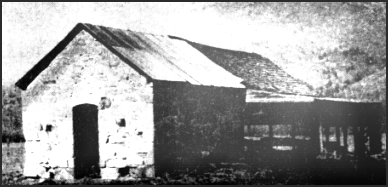
Mt. Vernon's Barn
by Joe Southworth
Why would a carefully built stone structure that looked like
part of a feudal fortress be in an area of rail and wire fences &
simple wood buildings?
But there it is, across the Mt. Vernon-
John Day highway from the Clarence Stratton home.
The answer includes some Scottish luck and begins when Mr. &
Mrs. David Jenkins rode horseback into the area in 1863. Their
year-old daughter rode much of the way standing in a pack sack
attached to a pack mule's saddle. In 1864 David Jenkins pre-empted
and homesteaded 240 acres of land around the fort site.
In 1875 or '76 a traveler riding a worn-out sorrel mare
traded her to Mr. Jenkins for a fresh horse so he could continue
his journey. The traveler told the unlikely story that the mare
was bred to the best trotting stallion in Kentucky.
Her chestnut-sorrel colt was named Mt. Vernon and became the
finest trotting horse in the area. When he was 3 years old in 1879,
the fort was built behind the Jenkins house to protect him from the
Indians.
Two old Scottish stone masons built the building. The stone
probably came from the hillside nearby. There two men also built
some of the better stone buildings in Canyon City. Then they went
south and built some fine stone structures in the Harney County
area.
The door of the fort facing the highway in opposite a window
in the other end. Above the window is an entrance to the attic.
Heavy wooden doors protected these three openings. The date 1879
is carved above the window. Hewn beams support the attic floor.
The original roof of clay dirt was supported by poles. The walls
are over a foot thick and amazingly even on the inside. There are
two small squarish openings in each wall.
Any creatures inside the building were quite safe. Any Indians
on the outside would have been, too. For these small openings
were not flared to be larger on the inside like gun holes in other
forts. So to be shot, an Indian would have had to have been accommodating
enough to stand directly in front of one of the openings,
as people inside could not have aimed or maneuvered their guns but
only shoot straight ahead.
The Jenkins house east of the fort was about where a hay stack
yard is located now. Stones near the northeast corner of the fort
are the remains of the old cellar which was between the house and
fort. Five or six feet of the cellar was below ground and lined
with the stones. A well beside the house was lined with river rock.
That well was filled with dirt in 1904 when a new house was built
where the Clarence Strattons live now.
In 1909 after Mr. & Mrs. David Jenkins had died, their daughter and
son-in-law, Mr. & Mrs. Alex McKenna, moved to the place. In 1920
they built the wooden section on the back of the fort for chickens.
That section was destroyed by recent winter storms.
When Mt. Vernon was between three and five years old, his mother
was stolen by six Indians. David Jenkins, who could talk some of the
Indian language, overtook them and brought his mare home. Since the
Indians preferred quality horses, Mt. Vernon would have been a valued
prize for a horse stealing raid.
Mt. Vernon was kept in the fort many nights, especially if there
were rumors about Indians in the vicinity. Some local people occupied
the fort for several days on one occasion during an Indian scare. But
the Indians crossed the John Day River near the Stewart ranch just east of Dayville.
Mt. Vernon was only beaten in one trotting race. Black Hawk,
owned by a Washington man, defeated him. David Jenkins drove him
that day, winning three races. He was so confident that he did not
bother to rest Mt. Vernon but went right into the fourth race and lost.
It was claimed that he was also beaten in a Portland race. But since
the time was not all announced, Grant County people did not accept
it as an official defeat.
Mt. Vernon weighed 1,100 pounds and was branded with a J on his
left shoulder. He accepted challenges to trotting races in various
places in Oregon. Many races were held at the old race track
west of Mt. Vernon where the Dennis Lemons ranch is located.
Of the numerous colts he sired, many were sold to the U.S.
Cavalry. Horses of his strain were still around here till 1920.
Several stallions from his line were used in the La Grande area for
breeding until 1918.
A Portland man purchased Mt. Vernon for breeding purposes when
he was 17 years old. Years later, Bill Alsop of Izee recognized the
famous horse on an eight-horse team near Athena. Mr. Alsop bought
him and brought him home to Grant County to retire on his Izee
ranch. It is believed that Mt. Vernon lived to be 41 years old.
Thanks to the following people for their time and information:
Mr. Ted McKenna and Mrs. Dora Walker, grandchildren of David Jenkins;
Mrs. Myrtle Stratton, Miss Nancy Stratton, Miss Shirley Stratton
and Mr. W.A. McKrola.
©1998 Roxann Gess Smith
All Rights Reserved
 ..... Return to Grant Co. - American Local History Network
.....