
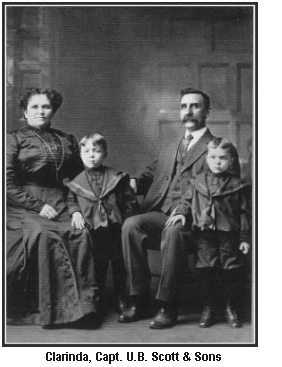
 Captain Uriah Bonser Scott was born in Sciotoville, OH on the Ohio river,
in the year 1827. At the age of ten he had to help make the family living,
so he apprenticed with an ironworker, and eventually became a master of the
trade. An ironworker was much more than a village blacksmith shoeing horses
and mules - he was a combination of practical engineer, mechanic, and
machinist. An artist in iron, steel, brass and bronze, he designed, made,
and repaired not only a wide range of metal products and implements used by
the settlers, but the tools and machinery to make those items.
Captain Uriah Bonser Scott was born in Sciotoville, OH on the Ohio river,
in the year 1827. At the age of ten he had to help make the family living,
so he apprenticed with an ironworker, and eventually became a master of the
trade. An ironworker was much more than a village blacksmith shoeing horses
and mules - he was a combination of practical engineer, mechanic, and
machinist. An artist in iron, steel, brass and bronze, he designed, made,
and repaired not only a wide range of metal products and implements used by
the settlers, but the tools and machinery to make those items.
In 1850, Uri and his older brother Perry opened a "mechanic shop" and axe
factory in the brand new town of Ironton, Ohio; serving the metalworking
needs of the townsfolk, iron smelters and passing steamboats on the Ohio
River. Scott Axes quickly became famous among the wood choppers at the
iron smelting furnaces of the Hanging Rock Iron Region of southern Ohio.
Each of the twenty or so furnaces in the area required one hundred or more
cords of wood per day for the charcoal to melt the iron out of its ore.
That made for a lot of chopping and the need for a lot of axes.
Ironton Register, Jan. 27, 1853 - Scott, Brother & Co. are doing a
driving business at Axe Manufacturing, on Third street - Their shop is now
altogether too small, such has been the increase in their business, and
they are contemplating the erection of a more extensive building the coming
spring. Their success is richly deserved, as they are very industrious and
very superior mechanics. We recently heard a chopper from Ohio Furnace say
that he had used their axes for three years, and had never known one to
FAIL; and the popularity of their axes may be known from the fact that
their orders are constantly in advance of their ability to supply.
In the spring of 1851, 24 year old successful businessman Uri Scott began
courting 18 year old Clarinda Lionbarger, who's father, Peter, had owned
part of the land on which Ironton had been built. Peter died in June of
1851. Uri and Clarinda were married in October of the same year. Over the
next 25 years they would raise seven children, only two of which, however,
would live to maturity.
Uri wasn't satisfied with just being a successful businessman, husband and
father. He wanted something more out of life. Because of his mechanic's
training and skills he was familiar with the design, construction and
repair of steam engines. Between 1850-54 he also became a part-time
steamboat engineer, and learned the rudiments of steamboat navigation and
management. The Ohio and other rivers were the superhighways of the time.
Steamboats carried passengers and freight thousands of miles in relative
comfort at high speed - 10-15 miles per hour. The lure of traveling on the
river and the excitement of being involved with the "high technology" of
the steamboats drew Scott like a magnet.
In 1854 Uri sold the axe factory and "went steamboating" full-time as
captain of the LILY, a small steamboat which he probably rebuilt from an
abandoned wreck. The LILY was sort of a "waterbus" packet. She had a
wider range than a normal ferry - not just across the river, but up and
down both shores to villages ten miles or so from Ironton - making several
trips per day. More conventional packet boats carried passengers and
freight perhaps a hundred miles per day, making round trips in their
"trade" every day or so.
Between 1855 and 1873 Capt. Scott was the designer, engineer, captain and
master of a dozen steamboats of varying sizes from 90-200 feet in length,
including the VICTOR's #1 #2, #3 and #4, and the famous sidewheelers
CHESAPEAKE and FASHION. He was instrumental in helping develop the class
of small, fast shallow draft sidewheel packets which became the hallmark
of Ohio river steamboating. During the Civil War, Scott served as a
civilian contractor, his boats transporting troops and supplies throughout
the inland rivers which drain into the Ohio and Mississippi.
Portland Oregonian, Nov. 11, 1906 - ...When the Civil War came he had
already built and sold several packets for the trade and was owner of one
and master of another when the Government impressed them for military
service. During the Rebellion he ran his boats in the Ohio, Mississippi
and Cumberland rivers, transporting troops and supplies for the Federal
armies. He was in the midst of war's alarums for four years, and his
service though in a civil capacity, was at times more hazardous than if he
had been a soldier.
After losing his money in the bank failures and business reverses which
presaged the Cooke Panic of 1873, Capt. Scott and his family took Horace
Greeley's advice and went west - to Oregon. Even before the Civil War,
thousands of Ohioans had been moving to the fertile valleys and mild
climate of Oregon and Washington. Capt. Scott and his family had friends
in the Portland area, and it was there that they settled.
Since 1850, steamboats on the Columbia and Willamette rivers had been built
as deep-draft oceangoing vessels rather than the "thin-water" riverboats
used on the Ohio and Mississippi. Capt. Scott found that the two companies
which monopolized the steamboating business on the Columbia and Willamette
weren't interested in his years of experience or his "crazy" ideas about
shallow-draft river boats. Rejected by the Oregon Railroad & Navigation Co.
and Peoples Transportation Co., Capt. Scott decided to go into business on
his own, as he had done back east.
In 1874 he borrowed $3000 from some Ironton friends who had come to Oregon
to operate the Oswego Iron Foundry, bought the machinery from an old steam
dredge, and began building the sternwheeler OHIO to use on the Willamette
river. The Willamette flows 185 miles from Eugene to Portland, it's
junction with the Columbia river. There, a major "seaport" gave access to
the world. The Willamette Valley was the "breadbasket" of the entire west
coast in those days; before modern irrigation techniques turned
California's deserts into croplands. But shallow water during the majority
of the year made it impossible for the usual deep draft steamboats to bring
the Willamette Valley's crops to market before the winter rains swelled
the river in November or December.
Scott didn't have much money, but he did the best he could with what he
had. The OHIO was 140 ft. long x 25 ft wide X 3 ft. depth of hold, and not
particularly pretty. In fact she looked like a shoebox with a smokestack
coming out of the top and a sternwheel tacked on one end. The old timers
sitting around the riverfront laughed at the strange looking craft being
built, and declared she wouldn't float. When the OHIO floated, they said
she would never go upstream against the current. When she went upstream
and came back loaded with cargo they quit laughing and wanted to buy a
piece of the action!
Empty, the OHIO sat only 9 inches deep in the water, and loaded with 100
tons of freight she drew only 18 inches. Such a shallow draft boat could
go up the Willamette as far as Corvallis or Eugene long before the deeper
draft "Company" boats could go more than a few miles from Portland.
Between October and December of 1874, Capt. Scott cleared $10-$12,000
hauling wheat and other produce from the Willamette Valley to Portland's
deep water port on the Columbia.
Portland Oregonian - Nov. 27, 1874 - Captain U.B. Scott's boat, the Ohio,
is now lying at the foot of Alder street undergoing a few temporary
repairs...On account of being extremely light draught the boat is able to
make regular trips during the lowest stage of water. She has ascended the
river as high as Corvallis without the least difficulty, and brought down
about twice a week large quantities of wheat and flour. One hundred and
seventy tons of freight are brought down on an average each trip, which
during a low stage of water. may be regarded as something remarkable. As
yet the Ohio has not ascended further than Corvallis, but when the river
rises a little more she will make the attempt to reach Eugene City.
With the money he made that first year, Capt. Scott then built the
sternwheeler CITY OF SALEM. The jeers and unkind remarks at his expense
caused by the appearance of the Ohio determined Capt. Scott that he would
never again own anything but the finest, most beautiful boats that money
could buy or build. When she was launched in 1875, the CITY OF SALEM was
the prettiest and most lavishly furnished steamboat on the Willamette if
not the entire Northwest.
Like the OHIO, the CITY OF SALEM was a shallow-draft boat. Capt. Scott
once took her eighteen miles up the Santiam river, a narrow tributary of
the Willamette, to the town of Jefferson - a stretch of river so shallow
that a rowboat would often run aground! The CITY OF SALEM also became a
popular summer excursion boat for picnics and other group outings around
Portland.
Within a year or two, other boatbuilders began copying Capt. Scott's
"radical" ideas of boat design, and he turned his interests to other areas.
He had proved his point - that shallow draft boats could be built and run
successfully on the Willamette by independent operators. The Companies
that had refused to hire him now tried to buy him out and remove him as a
competitor. But he refused to be bought, and continued his private "war"
against the monopolies for over thirty years.
In 1881 Capt. Scott designed and built the FLEETWOOD, a fast
propeller-driven passenger steamer that made him a small fortune (and cost
'the Companies' that same fortune). She started on the Columbia, taking
passengers from Portland to the Cascades, then shifted to the Portland to
Astoria run. Later she was moved to Puget Sound. In 1889 the FLEETWOOD
raced from Olympia to Seattle, WA, setting a speed record while bringing
firemen and a pumper to help put out a massive fire that was ravaging the
city.
In August of 1887 the telephone came to Portland, and the U.B. Scott
Steamboat Co. was one of the first thirty subscribers to this marvel of
modern technology. However, two years earlier Capt. Scott had launched a
technological marvel of his own - the sternwheeler TELEPHONE. On July 2,
1887 the TELEPHONE became the "fastest sternwheeler in the world".
Ironton Register Jul. 14, 1887 - FAST TIME - Capt. U. B. Scott, formerly
of Ironton, enjoys the distinction of having the fastest sternwheel boat in
the world. It is the Telephone, built by himself, and now running on the
Columbia river, Oregon. July 2, she made a trip from Portland to Astoria,
110 miles, in 4 hours and 34 3/4 minutes.
Twenty-five miles an hour was a phenomenal speed in those days! His
steamboat designs made Capt. Scott so famous that he and they were written
up in a now unfortunately lost supplemental issue of Scientific American
magazine.
On the evening of November 20th, 1887, the TELEPHONE caught fire just as
she was coming into Astoria. In a dramatic attempt to save his passengers
and cargo, Capt. Scott rammed the flame engulfed boat ashore at full speed.
The passengers were saved, but the boat and cargo burned to the waterline
within just a few minutes. She was towed back to Portland, re-built, and
went on to serve the passenger and freight needs of the Columbia river and
Puget Sound until 1905!
In 1891, Scott merged his Columbia Transportation Company with John Leary's
Seattle Steam Navigation & Transportation Co., and Capt. Scott became
president of the new Columbia River and Puget Sound Navigation Company.
Leary had built the sternwheeler BAILEY GATZERT for the Puget Sound; but
the new company brought her to the Columbia River, and sent their speedy
new propeller steamer, the FLYER, to the Sound. The moves were made to
better their chances in competitions against rival steamboat companies.
The BAILEY was not only beautiful, but fast, and she became so well-known
and popular with Portlanders that a song was even written in her honor.
For nearly 22 years the FLYER made four trips a day between Seattle and
Tacoma, so regularly that people often set their watches by her arrival
times. During that time the FLYER traveled nearly 1.5 million miles and
carried almost 4 million passengers, a record that has never been beaten by
any other river or sound steamer in the world.
Capt. Scott and the Columbia River and Puget Sound Navigation Company also
designed and built the TELEGRAPH, CITY OF EVERETT, and other boats on the
Sound and the Columbia. Captain Scott died in 1913 at the age of 86. In
some sense, he was the last of that breed of Victorian
inventor-entrepreneurs who believed, and often proved, that they could do
or make anything they set their minds to regardless of the obstacles.
Scott's nearly 70 year career was truly ubiquitous -- ironworker,
inventor, steamboat designer, engineer, captain, and businessman -- any one
of which would have been career enough for most men. His efforts made
significant contributions to the history and development of steamboating on
the Ohio, Columbia and Willamette rivers, and Puget Sound. In modern times,
two US Postage stamps have honored his boat designs. The "History of Mail
Delivery" series shows his sidewheel mail packet Chesapeake, and the "River
Boat" series pictures the sternwheeler Bailey Gatzert.
