|
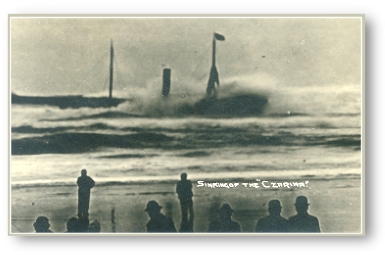
"Not in a quarter of a century has there occurred within the score of the service such an appalling marine casualty as the wreck of the steamer Czarina at the mouth of Coos Bay, Oregon, January 12, 1910." |
|
When the disaster chronicled she was on her way from Marshfield, Oregon [Coos Bay] to San Francisco, Calif. with a cargo of coal, lumber, and cement. 40,000 feet of lumber was stowed on her deck; with an estimated cargo value of $20,000. She carried a crew of 23 men and one passenger, all but one surrendered his final breath to the sea. |
|
|
|
The Czarina left port at 11:15 a.m., Jan. 12th, 1910. The sky was partly cloudy, the east wind was blowing and the sea was turbulent. All seemed to be going well as she navigated down the long narrow bay, making the last turn in the channel, she was headed straight out toward the open sea. Capt. W. A. Magee, master of the harbor tug Astoria, watched the Czarina as she navigated the bay. He would later testify that when she had worked her length beyond the black buoy, where the channel turns towards the ocean, she seemed suddenly to lose headway, stop, and move backward; then there came a momentary lull in the sea, and she went ahead again. She "seesawed" back and forth for several minutes in the manner described, then swung her head well to the northward, as if she intended to try for a less difficult passage to starboard. Shortly, however, she swung around to the southwest and went unsteadily forward until she brought up on the South spit. Then she blew a distress signal. Under extremely perilous conditions, that no prudent mariner would have ever risked navigating, the Czarina had chosen to foolishly place herself directly in harms way. Capt. Magee, four miles away in a tower at Empire City, hurried to her rescue, but by the time he reached the bar the Czarina had already drifted across it and was headed along the beach northward. He explained as follows: It would now seem that the captain of the Astoria anticipated that the steam schooner Nan Smith, would assist in the Czarina's recovery, an event that would sadly never occur. The steam schooner Nan, was itself too heavily loaded with lumber. It made one attempt to rescue the imperiled Czarina, but under the extreme weather conditions became apprehensive of the danger involved and turned back. It would later be said by the only survivor of the shipwrecked Czarina, that had the Astoria risked the bar and gotten safely offshore, she might, at any time before the Czarina foundered, have been able to drift a line down to that vessel. The Czarina settled broadside, parallel to the beach - 1,860 ft. from shore. Too far for the reach of a godly hand and too close to the ungodly end, she was buffeted and rocked by strong winds and fierce waves throughout the horrible night. Bystanders lit fires to offer comfort to the poor exhausted souls clinging to the ships riggings. The next day brought little comfort. Conditions had worsened and the men could still be seen hanging helplessly to the now splintered riggings. Bystanders watched in horror as one-by-one they dropped to their deaths. Some would just loosen their grip on life and surrender to the sea, while others borrowed a second breath and dropped to the deck below, only to be robbed of their third. Of a crew of 24 men and one passenger, there was only one survivor of the Czarina. Harry Kentzel, 1st assistant engineer clung tightly to a piece of timber, which ultimately carried him safely into shore. |
|
On Jan. 13th, 1910, six members of the Coquille River Life Saving Station were called in to retrieve bodies and to avert looting. Two men of the Coos Bay Life Saving team would eventually be charged with plundering and suspended from their positions. The Keeper of the Life Saving Station was charged with failure to fulfill his duties and professional unfitness. He would later resign his position. An Annual Report of the United States Life Saving Service would note this horrible event as "an appalling marine casualty." |
